3.5 Firewall Management
Firewall rules aren't a single mechanism — Google currently offers three layers, each with a different scope and precedence:
| Mechanism | Scope | Characteristics |
|---|---|---|
| Hierarchical firewall policy | Attached to the Organization or a Folder, inherited down to every project | Lower-level rules can never override a higher-level rule — put your company-wide security baseline here, and one change applies everywhere |
| Network firewall policy (global/regional) | Attached to one or more VPCs | Each VPC's own rules, for needs specific to that network |
| VPC firewall rules (legacy mode) | A single VPC | The oldest mechanism — Google's own Security Foundations Blueprint no longer uses it, relying on the two layers above instead |
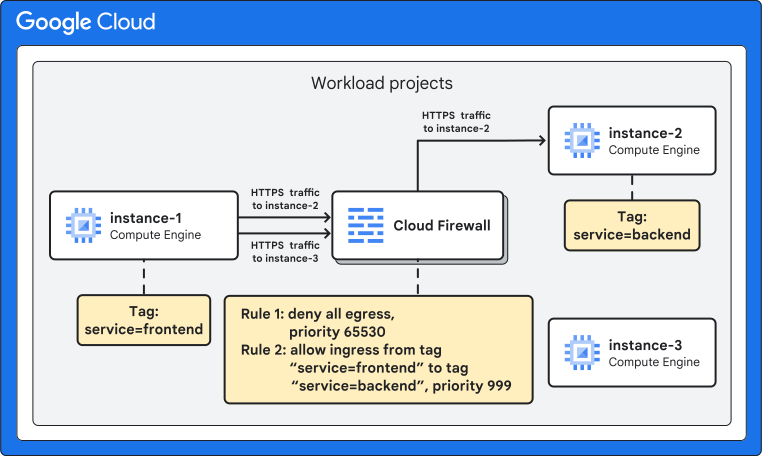
Google's own blueprint approach: attach a hierarchical firewall policy to every folder, covering RFC 1918 internal traffic, IAP TCP forwarding (35.235.240.0/20), and Load Balancer health-check source ranges (35.191.0.0/16, 130.211.0.0/22) — these are the baseline rules every company needs allowed. Rules specific to an individual VPC are then layered on separately via a network firewall policy. The guiding principle is one sentence: deny everything by default, and open only the traffic you actually need (micro-segmentation) — not the other way round, starting wide open and patching holes as you go.
The actual hierarchical firewall policy Terraform lives in the network-design/ sub-project.