3.3 Private Access & Cloud DNS
If a VM only has an internal IP (per Section 2.2's compute.vmExternalIpAccess policy), how does it reach Google APIs? Two mechanisms:
- Private Google Access: a subnet-level switch that lets internal-IP-only instances reach Google APIs' public endpoints. Simple to set up, but doesn't support regional or multi-regional endpoints.
- Private Service Connect (PSC): creates an endpoint using an internal IP inside your own VPC, so traffic never leaves Google's network at all. Google's own Security Foundations Blueprint currently uses exactly this — PSC combined with a private DNS zone — rather than relying on Private Google Access alone.
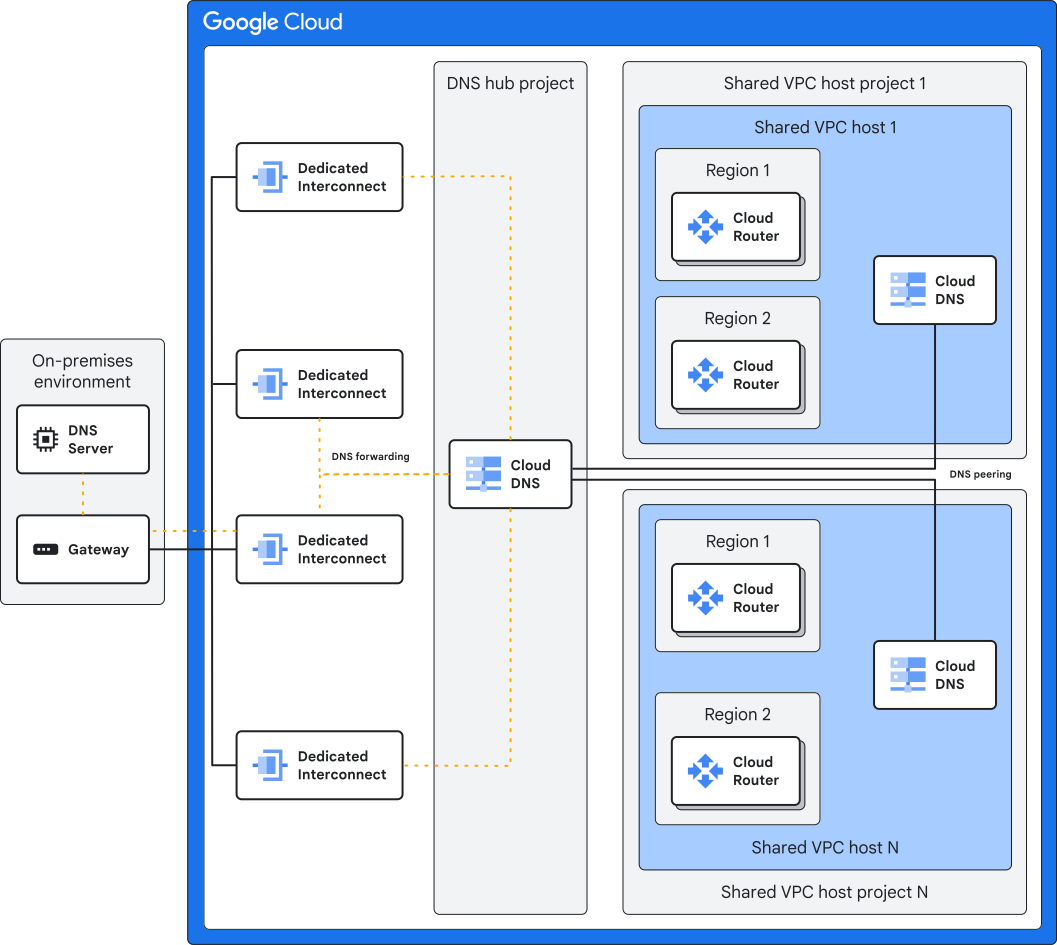
For Cloud DNS, in a multi-environment or multi-VPC architecture it's worth designing a centralised DNS hub: on-premises domains are handled via DNS forwarding to your on-prem DNS servers, while lookups between VPCs inside Google Cloud go through DNS peering (peering connections can't forward DNS queries themselves, which is exactly why a multi-VPC setup needs a dedicated DNS hub design rather than having each VPC forward independently).